Luminous Renewal Cell Turnover Toner
Formulated For
This product is suitable for skin presenting with:
Melasma. Symmetrical patches of deeper pigment, typically across the cheeks, forehead and upper lip, driven by hormonal, vascular and inflammatory input alongside UV exposure.
Hyperpigmentation and uneven tone. Generalised darkening or patchiness where pigment production and transfer to the surface layers have become dysregulated.
Post inflammatory hyperpigmentation. The marks left after acne, injury or irritation, where the inflammatory event itself has triggered local pigment production. Commonly called acne marks.
Solar lentigines. Discrete darker spots following cumulative sun exposure. Commonly called sun spots.
Textural irregularity and congestion. Rough surface, visible follicles and blocked pores, where the shedding of surface cells has slowed and corneocytes are being retained.
Dull skin with slow turnover. Where pigment sits in the upper layers longer than it should because the surface is not renewing at pace.
Formulated for use across all Fitzpatrick phototypes, the classification scale from I to VI describing how skin responds to UV exposure. The acid selected here is mandelic rather than glycolic specifically for that reason, explained below.
Placement in the routine. First step after cleansing, before the PWR Multi Peptide Serum and the Luminous Renewal Complex Cream.
Use notes. This formula contains an alpha hydroxy acid. Introduce gradually rather than daily from the outset, and do not layer with other exfoliating products in the same routine. Acids increase the skin’s sensitivity to UV, and UV is the single most reliable driver of the pigment you are working to correct.
Daily photoprotection is not optional with this product. Use the Advanced Protective Sun Lotion and the Luminous Glass Skin Tinted SPF from the range diligently, every day, including indoors and in winter. The tint is not cosmetic. The iron oxides that give it colour are what block visible light, and visible light drives pigment production in deeper phototypes through a pathway that a clear sunscreen leaves entirely open. Without this step, the correction achieved by every other product in the system is undone faster than it is made.
Formulation Architecture
A toner in a clinical protocol is not a residue remover and it is not a finishing step. It is the first delivery point. Applied to damp skin immediately after cleansing, it meets the stratum corneum at its most permeable, before any occlusive layer is in place. That is the moment to deliver the water soluble active load and to set the surface condition for everything applied afterwards.
This formula is unusually concentrated for its category. Niacinamide sits second in the ingredient list and Alpha-Arbutin sixth, which places both above the level at which most brands would position them in a leave on product, let alone a toner.
Surface Renewal
Mandelic Acid
An alpha hydroxy acid derived from bitter almond. It works by interfering with the ionic bonds holding corneocytes, the flattened dead cells of the surface layer, to one another, which accelerates their shedding and allows the layers beneath to surface sooner.
The choice of mandelic over glycolic is deliberate and it is the most important formulation decision in this product. Mandelic acid has a molecular weight of roughly 152 daltons against glycolic acid’s 76, meaning the molecule is around twice the size. A larger molecule crosses the barrier more slowly and more evenly, producing a lower peak concentration in the tissue at any one moment. It is also more lipophilic, meaning more oil compatible, which gives it access to the follicular opening where congestion sits.
Slower and more even matters clinically. A rapid acid load provokes an inflammatory response, and inflammation is one of the direct triggers of melanogenesis. In deeper phototypes that response reliably produces post inflammatory hyperpigmentation, which means an aggressive acid used on pigmented skin can generate the exact problem it was applied to correct. Mandelic acid also carries documented antibacterial activity, relevant where congestion and marking occur together.
Allantoin
A skin protectant with a dual role. It supports the shedding of surface cells while simultaneously forming complexes with irritant molecules, reducing their capacity to provoke a reaction. In an acid containing formula it is a deliberate counterweight, not a filler.
Pigment Pathway Actives
Niacinamide (Vitamin B3)
Does not act on tyrosinase, the pigment producing enzyme. Niacinamide interferes with the transfer of finished melanosomes, the pigment carrying organelles, from the melanocyte to the surrounding keratinocytes, a step mediated in part by PAR-2 receptor signalling. Pigment that is produced but never transferred does not reach the visible layers. As a precursor to NAD+ and NADPH it also supports the enzymatic machinery of ceramide and fatty acid synthesis in the barrier, which is why it pairs logically with an acid.
Alpha-Arbutin
A competitive inhibitor at the tyrosinase active site. Tyrosinase is the rate limiting, copper dependent enzyme that converts tyrosine into the precursors of melanin. Alpha-Arbutin occupies the site without being converted itself, slowing the reaction rate. It is formulated within a controlled pH window to keep the glycoside intact and to prevent hydrolysis of the molecule over shelf life.
Dimethyl Sulfone (MSM)
An organosulfur compound and a bioavailable sulfur donor. Sulfur is required for cysteine, and cysteine is the rate limiting building block of glutathione, the body’s principal intracellular antioxidant. Within melanogenesis, thiol compounds act at the branch point determining whether the pigment produced is darker eumelanin or lighter pheomelanin, and thiol groups coordinate copper, the cofactor tyrosinase depends on. Dimethyl sulfone is also studied for its effect on membrane permeability, which is relevant to the delivery of everything alongside it.
Botanical Architecture
The botanical selection is drawn from the Traditional Chinese Medicine materia medica and chosen for phytochemistry that maps onto the same pathways as the actives above: inflammatory signalling, oxidative load, and enzyme inhibition. In an acid containing formula their role is also structural. They sit against the irritation potential of the acid rather than decorating the label.
Scutellaria Baicalensis Root Extract (Huang Qin)
Supplies baicalin and baicalein, flavone glycosides documented for free radical scavenging and for inhibition of inflammatory signalling cascades.
Sophora Angustifolia Root Extract (Ku Shen)
Contains prenylated flavonoids including kurarinone, and the alkaloid matrine. The flavonoid fraction shows direct tyrosinase inhibitory activity in vitro.
Ledebouriella Divaricata Root Extract (Fang Feng, Saposhnikovia)
A chromone rich root supplying prim-O-glucosylcimifugin and 4’-O-β-D-glucosyl-5-O-methylvisamminol. Used in TCM to address wind heat patterns. Its chromone constituents are studied for anti inflammatory activity.
Eclipta Prostrata Extract (Han Lian Cao)
Source of wedelolactone, a coumestan with documented antioxidant and enzyme modulating activity. In TCM it is a kidney and liver yin tonic, the organ systems classically implicated in chronic facial pigmentation.
Calendula Officinalis Flower Extract
Faradiol triterpenoid esters, the constituents responsible for its documented skin conditioning and soothing activity.
Hydration and Barrier
Glycerin, Butylene Glycol, Propylene Glycol
Humectants drawing and holding water in the stratum corneum, and carriers for the water soluble active load. A well hydrated corneum is also a more permeable one, which is part of why this step precedes the serum rather than following it.
Arginine
An amino acid component of the skin’s own natural moisturising factor, which also contributes to pH adjustment of the finished formula. In a product containing both an acid and an acid sensitive glycoside, that second function is doing real work.
Formulation Integrity
Hydroxyacetophenone, 1,2-Hexanediol
Multifunctional ingredients providing antimicrobial protection and antioxidant support, allowing a reduced conventional preservative load. Hydroxyacetophenone additionally functions as a free radical scavenger, which matters in a water based formula carrying oxidation prone actives.


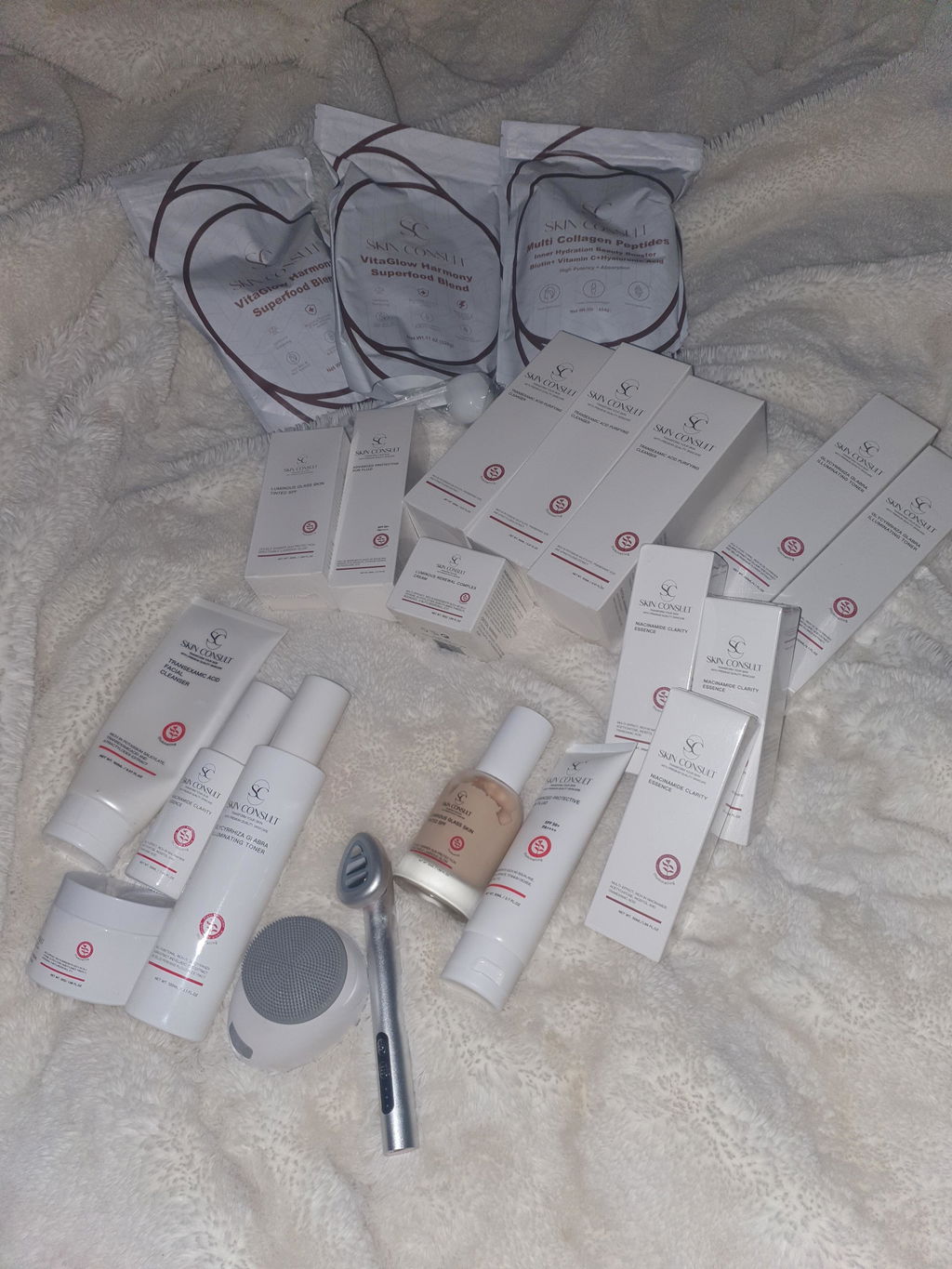
 Glow Within Wellness Duo | Inner Beauty & Wellness Supplement Duo
£87.99
VIEW
Glow Within Wellness Duo | Inner Beauty & Wellness Supplement Duo
£87.99
VIEW