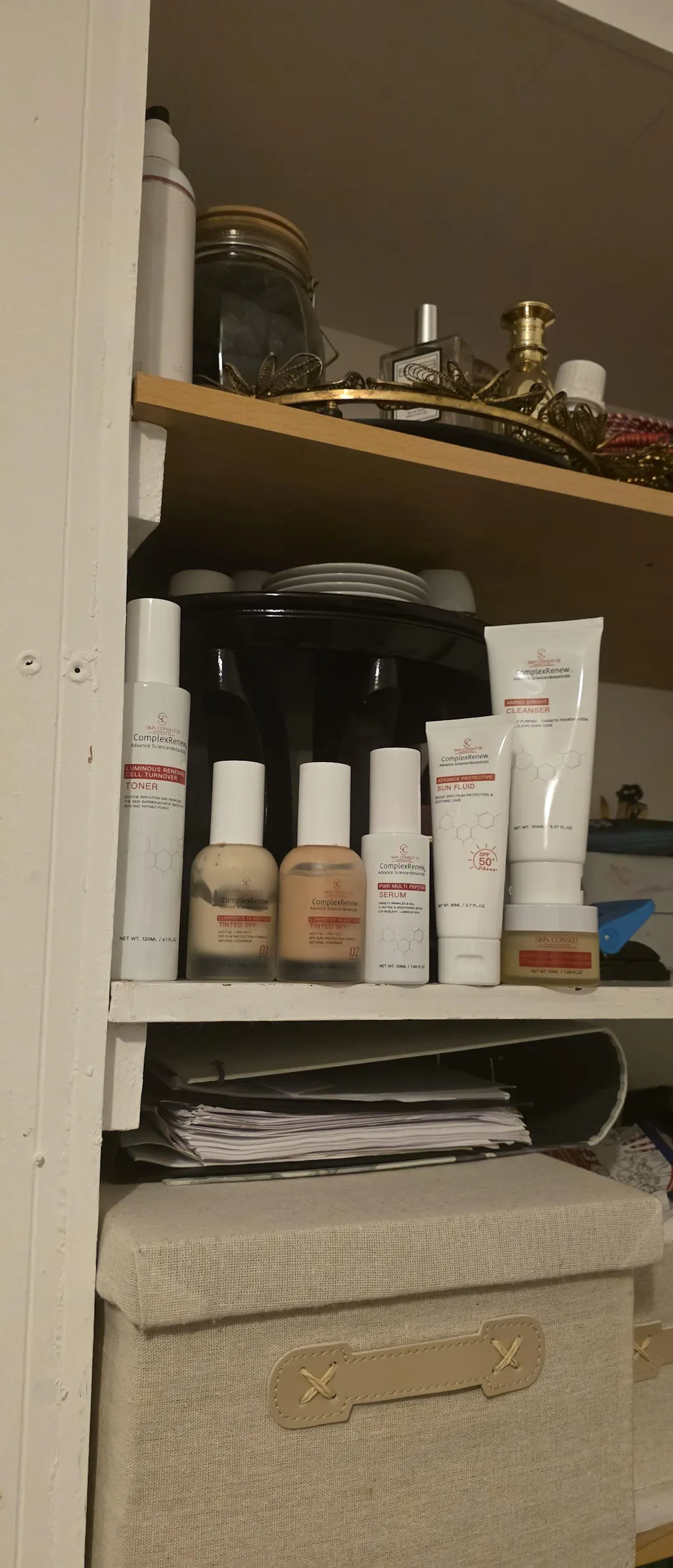
PWR Multi Peptide Serum
Formulated For
This product is suitable for skin presenting with:
Visible ageing and expression lines. Lines produced and deepened by repeated muscle movement, addressed here at two separate points of the neuromuscular junction rather than one.
Melasma and hyperpigmentation. Particularly where there is a visible vascular component, meaning underlying redness or increased vessel activity sitting beneath the pigment, which is characteristic of melasma and frequently left untreated.
Dry and dehydrated skin. These are two different problems. Dryness is a shortage of lipid. Dehydration is a shortage of water. This serum is built on humectants and works on the water deficit, which is why it is layered beneath a lipid containing cream rather than used alone.
Sensitive and reactive skin. The formula carries no acid, no retinoid, no essential oil and no added fragrance.
Compromised or recovering barrier. Suitable during periods of barrier repair, including after in clinic procedures once the skin has closed.
Formulated for use across all Fitzpatrick phototypes, the classification scale from I to VI describing how skin responds to UV exposure.
Placement in the routine. Applied to cleansed skin before the Luminous Renewal Complex Cream. The serum delivers, the cream seals and supplies the lipid phase.
Daily photoprotection is not optional with this product. Use the Advanced Protective Sun Lotion and the Luminous Glass Skin Tinted SPF from the range diligently, every day, including indoors and in winter. The tint is not cosmetic. The iron oxides that give it colour are what block visible light, and visible light drives pigment production in deeper phototypes through a pathway that a clear sunscreen leaves entirely open. UV also acts directly on the vascular and inflammatory components this serum is formulated to address, which means unprotected exposure works against it at the same point it works.
Formulation Architecture
A serum is not a lighter moisturiser. It is a delivery vehicle. Its job is to carry small, unstable, poorly soluble molecules through the stratum corneum and release them intact at the layer where they act. Everything below is either an active, or part of the system that gets the actives where they need to be.
This serum works on two problems that present together and are usually treated separately: the expression lines produced by repeated muscle contraction, and the pigment and vascular activity that sits underneath uneven tone. Applied within the ComplexRenew sequence, it precedes the Luminous Renewal Complex Cream.
The Delivery System
Cyclodextrin
A ring shaped oligosaccharide, meaning a circle of linked sugar units. The outside of the ring is water loving and the internal cavity is water repelling. That structure lets it form an inclusion complex: an unstable or poorly water soluble molecule sits inside the cavity, shielded from oxygen and from other reactive ingredients in the formula, and is released gradually once applied. It functions as encapsulation without a capsule.
Diethoxydiglycol
A high solvency carrier used to hold peptides and poorly soluble actives in true solution and to improve their movement into the upper layers of the stratum corneum. An active suspended rather than dissolved does not deliver.
Bis-PEG-18 Methyl Ether Dimethyl Silane
A water soluble silicone hybrid. It contributes the slip and even spread of the serum and forms a light breathable film, which slows water loss from the surface and holds the active layer in contact with the skin for longer.
Euglena Gracilis Extract
A single celled microalga grown under controlled culture. Its value is paramylon, a beta-1,3-glucan storage polysaccharide. Beta glucans of this class are studied for their interaction with pattern recognition receptors on skin immune cells, and for water binding and film forming behaviour at the surface. This is the fermentation derived component of the formula: the constituent is produced by the organism under culture conditions rather than extracted from a harvested plant.
Peptide Actives
Both peptides in this formula act on the neuromuscular junction, the point where a nerve signals a muscle to contract. They do so at two different stages of that signal, which is why they are used together rather than interchangeably.
Acetyl Hexapeptide-8
An acetylated six amino acid chain designed to mimic a segment of SNAP-25, one of the proteins that assembles the machinery allowing neurotransmitter filled vesicles to dock and release their contents. By competing for a position in that assembly, it is studied for its effect on the efficiency of vesicle release. This is action at the presynaptic side, before the signal has been sent.
Dipeptide Diaminobutyroyl Benzylamide Diacetate
A synthetic peptide modelled on waglerin-1, a molecule originally characterised in the venom of the Temple viper. It is studied as an antagonist at the postsynaptic nicotinic acetylcholine receptor, occupying the site so that the arriving signal is not fully received. This is action on the receiving side, after the signal has been sent.
Presynaptic and postsynaptic. Two points on the same pathway, which is the same logic applied throughout the ComplexRenew range.
Hydrolyzed Collagen
Collagen broken by enzymatic hydrolysis into short peptide fragments. Intact collagen is far too large to cross the stratum corneum, and topical collagen is not incorporated into the dermal matrix. What the hydrolysate does is bind water and form a smoothing film at the surface, with research interest in whether specific peptide fragments act as signalling matrikines.
Pigment and Sulfur Pathway
Dimethyl Sulfone (MSM)
An organosulfur compound and a bioavailable sulfur donor. Sulfur is not decorative in skin biology. It is required for cysteine, and cysteine is the rate limiting building block of glutathione, the body’s principal intracellular antioxidant. Within melanogenesis, thiol compounds act at the branch point that determines whether the pigment produced is darker eumelanin or lighter pheomelanin, and thiol groups coordinate copper, the cofactor the tyrosinase enzyme depends on to function. Dimethyl sulfone is also studied for its effect on membrane permeability, which is relevant to how the rest of the formula moves.
Vascular and Antioxidant Support
Sophora Japonica Bud Extract
The unopened flower buds of the pagoda tree, known in Traditional Chinese Medicine as Huai Hua Mi and used in the cooling blood category. Pharmacologically it is the principal commercial source of rutin, a flavonoid glycoside, alongside quercetin. Rutin is documented for antioxidant activity and for its effect on capillary fragility and vascular permeability.
That second property is the reason it is here. Melasma is not a purely melanocytic condition. Affected skin shows increased vessel density and vascular activity, and the mediators released from that vasculature feed the same signalling that drives pigment production. A botanical acting on the vascular arm is addressing a component that most brightening formulas do not acknowledge exists.
Matrix and Hydration
Glycosaminoglycans
The polysaccharide chains that form part of the extracellular matrix, the structural gel surrounding cells in the dermis. Applied topically they act as high capacity humectants, binding water many times their own weight at the surface.
Sodium Hyaluronate
The sodium salt of hyaluronic acid, the most abundant glycosaminoglycan in skin. Binds water within its molecular structure and holds it in the upper layers.
Glycerin, Butylene Glycol, Pentylene Glycol
Humectants drawing and holding water in the stratum corneum, and carriers for the water soluble portion of the active load.
Arginine
An amino acid component of the skin’s own natural moisturising factor, which also contributes to pH adjustment of the finished formula.
Sarcosine
N methylglycine, an amino acid derivative present in the natural moisturising factor. Studied for skin conditioning and for its effect on sebaceous activity.
Formulation Integrity
Hydroxyacetophenone, 1,2-Hexanediol
Multifunctional ingredients providing antimicrobial protection and antioxidant support to the formula, allowing a reduced conventional preservative load. Peptides are biological molecules and are vulnerable to microbial degradation, so preservation in a peptide serum is a stability requirement rather than a formality.
Xanthan Gum, Carbomer
The rheology system, controlling flow and holding the formula in a stable single phase so that dose is consistent from first application to last.
PEG-40 Hydrogenated Castor Oil PCA Isostearate
A solubiliser holding the small oil soluble fraction dispersed within a water based serum without requiring a heavy emulsion structure.


 Glow Within Wellness Duo | Inner Beauty & Wellness Supplement Duo
£87.99
VIEW
Glow Within Wellness Duo | Inner Beauty & Wellness Supplement Duo
£87.99
VIEW